table
{mso-displayed-decimal-separator:"\.";
mso-displayed-thousand-separator:"\,";}
tr
{mso-height-source:auto;}
col
{mso-width-source:auto;}
td
{padding-top:1px;
padding-right:1px;
padding-left:1px;
mso-ignore:padding;
color:black;
font-size:11.0pt;
font-weight:400;
font-style:normal;
text-decoration:none;
font-family:Calibri, sans-serif;
mso-font-charset:0;
text-align:general;
vertical-align:bottom;
border:none;
white-space:nowrap;
mso-rotate:0;}
.font82
{color:windowtext;
font-size:11.0pt;
font-weight:400;
font-style:normal;
text-decoration:none;
font-family:"Aptos Narrow", sans-serif;
mso-font-charset:0;}
.font87
{color:windowtext;
font-size:11.0pt;
font-weight:700;
font-style:normal;
text-decoration:none;
font-family:"Aptos Narrow", sans-serif;
mso-font-charset:0;}
.xl362
{color:windowtext;
font-family:"Aptos Narrow", sans-serif;
mso-font-charset:0;
text-align:left;
vertical-align:top;
border:.5pt solid #A5A5A5;
background:#E2EFDA;
mso-pattern:black none;
white-space:normal;}
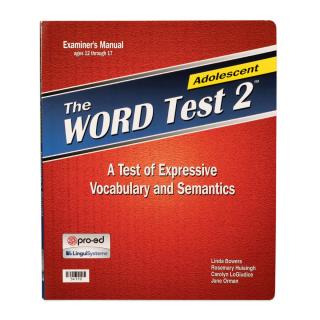
The WORD Test 2 Adolescent identifies semantic weaknesses that impact academic, social, and vocational success by examining a student's expressive vocabulary and semantic skills. It measures a student's facility with language and word meaning using common and unique contexts. The test surveys six semantic and vocabulary skill areas reflective of curriculum vocabulary and everyday usage Each of the six subtests is composed of 15 items.
Age range: 12:0 - 17:11 years Publication date: 2005
Notice: Individuals should administer only those tests for which they have the appropriate training and expertise. This test requires a PRO-ED, Inc Level A qualification. |