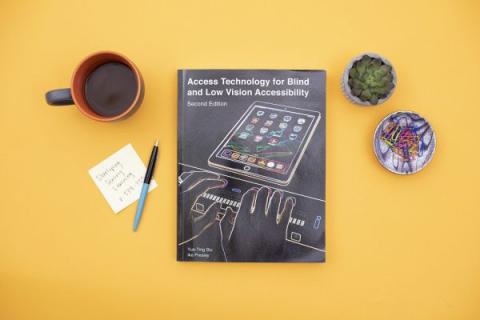
Access Technology for Blind and Low Vision Accessibility is the second edition of the book, previously named Assistive Technology for Students Who Are Blind or Visually Impaired: A Guide to Assessment. “This book represents a shift in how blind and low vision individuals can be empowered to engage, produce, and design their own access to information,” explains one of the book’s authors, Yue-Ting Siu. “The emphasis is not on how sighted assistance can provide support with assistive technology – rather, the emphasis is on how technology can be leveraged for interdependence so that every individual can better dictate how, or if, assistance is needed.
Rather than using pre-determined checklists to evaluate technology skills, authors Yue-Ting Siu and Ike Presley present an inquiry-based approach for identifying needs related to individual instruction, advocacy for accessible formats, and how to achieve equity in information-rich environments.
The central theme of the textbook is equity. This edition raises important questions of how to empower student who are blind or visually impaired when it comes to finding the right tools for their needs. Service providers must facilitate students’ mediation of accessibility challenges and foster the development of skills for technology proficiency and independence in physical and digital worlds.